Cutting Boards
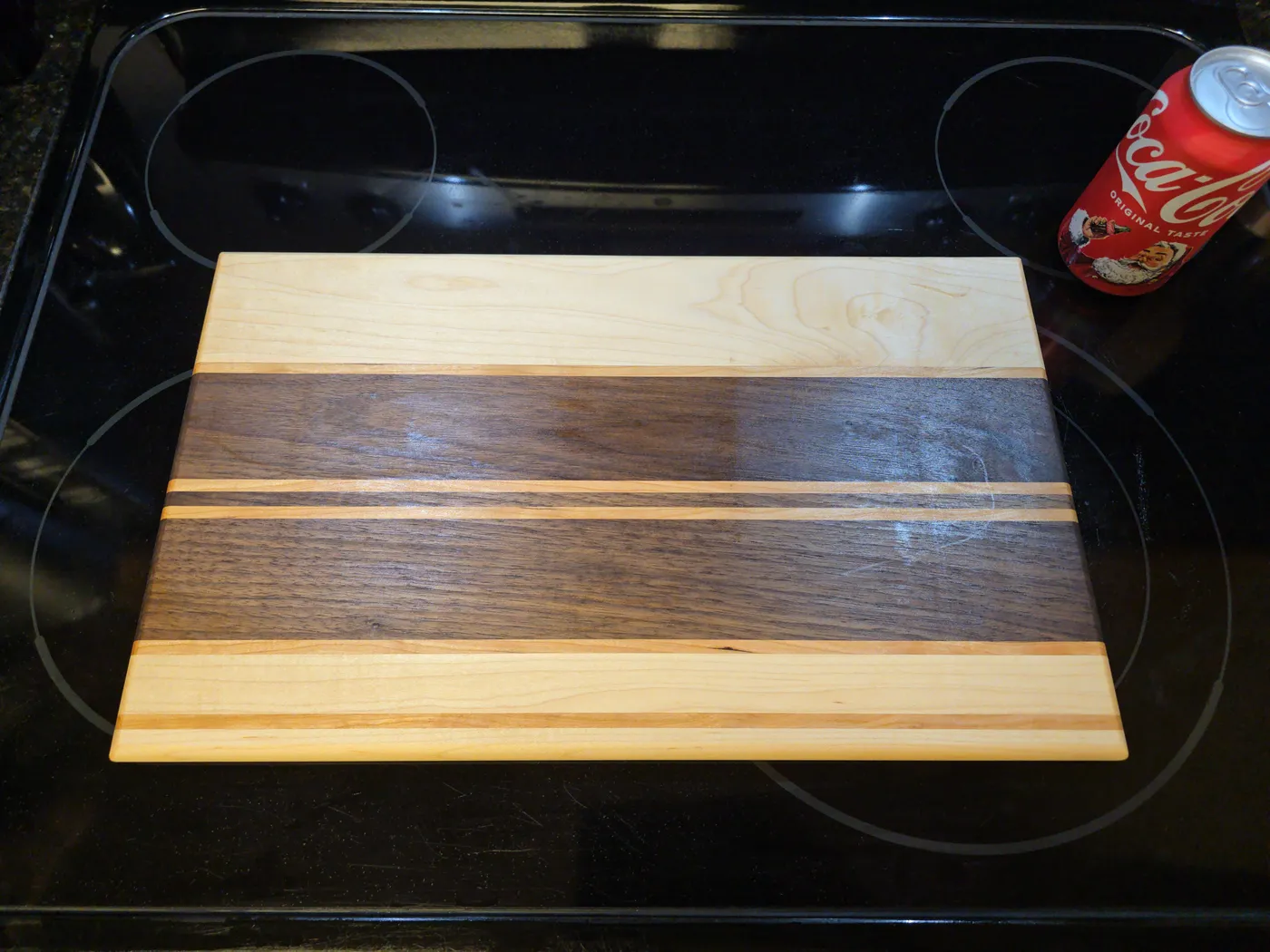
A batch of simple hardwood cutting boards built from spare shop stock — walnut, cherry, hard maple, and bloodwood — made as holiday gifts.
Every woodworker eventually makes a cutting board — it’s basically the hobby’s rite of passage. I’d already been through the finesse-heavy stuff (jewelry boxes, the kind of project that punishes a fraction of a degree), so when a pile of spare walnut, cherry, hard maple, and bloodwood started taking up shelf space, a batch of cutting boards was exactly the low-stakes, good-looking win I wanted. Quick, forgiving, and it burns through scrap instead of letting it rot in a corner.
“Low-stakes” turned out to be relative. My first two attempts don’t show up in the gallery — I let a strip jump slightly on the table saw, which left the edge a hair out of flat, and a glue line that isn’t dead flat leaves tiny gaps in the seam. Tiny gaps mean a board that traps moisture and grime instead of shedding it — porous, unsanitary, not worth trying to save, and I knew it going in. So I didn’t try. I finished those two anyway with a hand plane, purely as throwaway practice, since I didn’t own an electric planer yet. Flattening an edge by hand takes actual hours and is miserable enough work that it’s the entire reason I own an electric planer now — the same job takes seconds once you’re not doing it by arm.
Everything after that went a lot smoother — and skipped the juice groove and rubber feet on purpose. Less cutting surface to eat into on boards this size, one less feature to keep clean, and two good flat faces per board means you flip it instead of babying one side.
Lumber for this batch ran about $17.80 a board foot, so each finished board worked out to roughly $20 in wood. Since most of these went out as holiday gifts, I dressed them up a bit — a small sample bottle of finishing oil and a little card with care instructions and a note about the wood species, taped to each one.